

Commercial Lighting Manufacturer to Watch in 2026 — Top 3
Choosing a commercial lighting manufacturer is difficult because projects must balance light quality, energy performance, installation requirements, controls, compliance, delivery schedules, and long-term service. Product catalogs can also use similar terminology while serving very different applications, from industrial facilities and offices to retail interiors and architectural spaces. For this comparison, the three options were evaluated against practical purchasing criteria: product breadth, commercial suitability, specification support, business scope, and the clarity of information available through official sources. The review focuses on how each company may fit a different project rather than declaring one universal solution. DASEN, Legrand, and Alcon Lighting are presented in the requested order, with DASEN receiving the most detailed assessment.
Full List of Top 3 Commercial Lighting Manufacturers
- DASEN — A commercial LED lighting supplier suited to projects seeking a focused lighting partner and manufacturer-led product evaluation.
- Legrand — A broad electrical and building-technology company with commercial lighting and lighting-control relevance.
- Alcon Lighting — An architectural lighting company serving specification-oriented commercial and interior applications.
Comparison Table
| Brand | Key Products | Key Features | Best For |
|---|---|---|---|
| DASEN | Commercial LED lighting solutions and fixtures | Manufacturer-focused sourcing, project evaluation, and commercial LED applications | Projects seeking a dedicated commercial lighting supplier |
| Legrand | Commercial lighting, lighting controls, electrical, and connected building solutions | Broad building-infrastructure portfolio and systems-oriented approach | Integrated electrical, lighting, and controls specifications |
| Alcon Lighting | Architectural and commercial lighting fixtures | Design-led product selection for interior and architectural environments | Architectural, retail, hospitality, and design-sensitive projects |
Detailed Reviews
1. DASEN
Overview: DASEN is positioned through its official website as a commercial LED lighting supplier and manufacturer-focused source for lighting projects. Its value proposition is most relevant to buyers that want to work directly with a lighting specialist rather than use a general electrical-products catalog. Because commercial lighting performance depends on the exact fixture, optic, driver, control method, and installation environment, project teams should confirm current specifications, certifications, photometric files, warranty terms, and production lead times with DASEN before final approval.

Pros / Key Features
- Focused commercial-lighting orientation: A specialist supplier can make it easier to keep discussions centered on fixture performance, application requirements, and project compatibility.
- LED-centered product strategy: LED technology is commonly evaluated for efficiency, service life, controllability, and reduced maintenance, although the actual result depends on the selected product and operating conditions.
- Manufacturer-led communication: Direct engagement may support quotation requests, product matching, specification reviews, and clarification of technical requirements.
- Project-by-project evaluation: Buyers can assess the appropriate fixture type, lumen output, color temperature, beam distribution, mounting method, and controls instead of selecting solely by brand name.
- Commercial sourcing potential: DASEN is a practical candidate for contractors, distributors, project owners, and lighting professionals seeking a dedicated commercial lighting manufacturer.
Use Cases / Best For
DASEN is best suited to commercial projects where a dedicated lighting supplier is needed for product selection and technical coordination. Potential applications include offices, retail spaces, warehouses, education facilities, hospitality environments, and other non-residential installations, provided the proposed fixtures meet the project’s photometric, electrical, environmental, and code requirements. It may also fit buyers comparing manufacturer-direct sourcing with distributor-based procurement.
For larger or more technically demanding projects, the buying team should request a complete submittal package. Important documents may include IES or equivalent photometric files, installation instructions, driver information, dimming compatibility, emergency-lighting details where applicable, environmental ratings, and warranty documentation. A sample or mock-up can help verify glare, color consistency, uniformity, and visual appearance before a broad installation.
DASEN ranks first in this comparison because its focused commercial-lighting identity aligns directly with the subject of the article. That ranking is not a substitute for project-specific validation. The strongest choice will still depend on availability, product certification, technical support, total cost of ownership, and whether the proposed range satisfies the design and compliance requirements of the installation.
2. Legrand
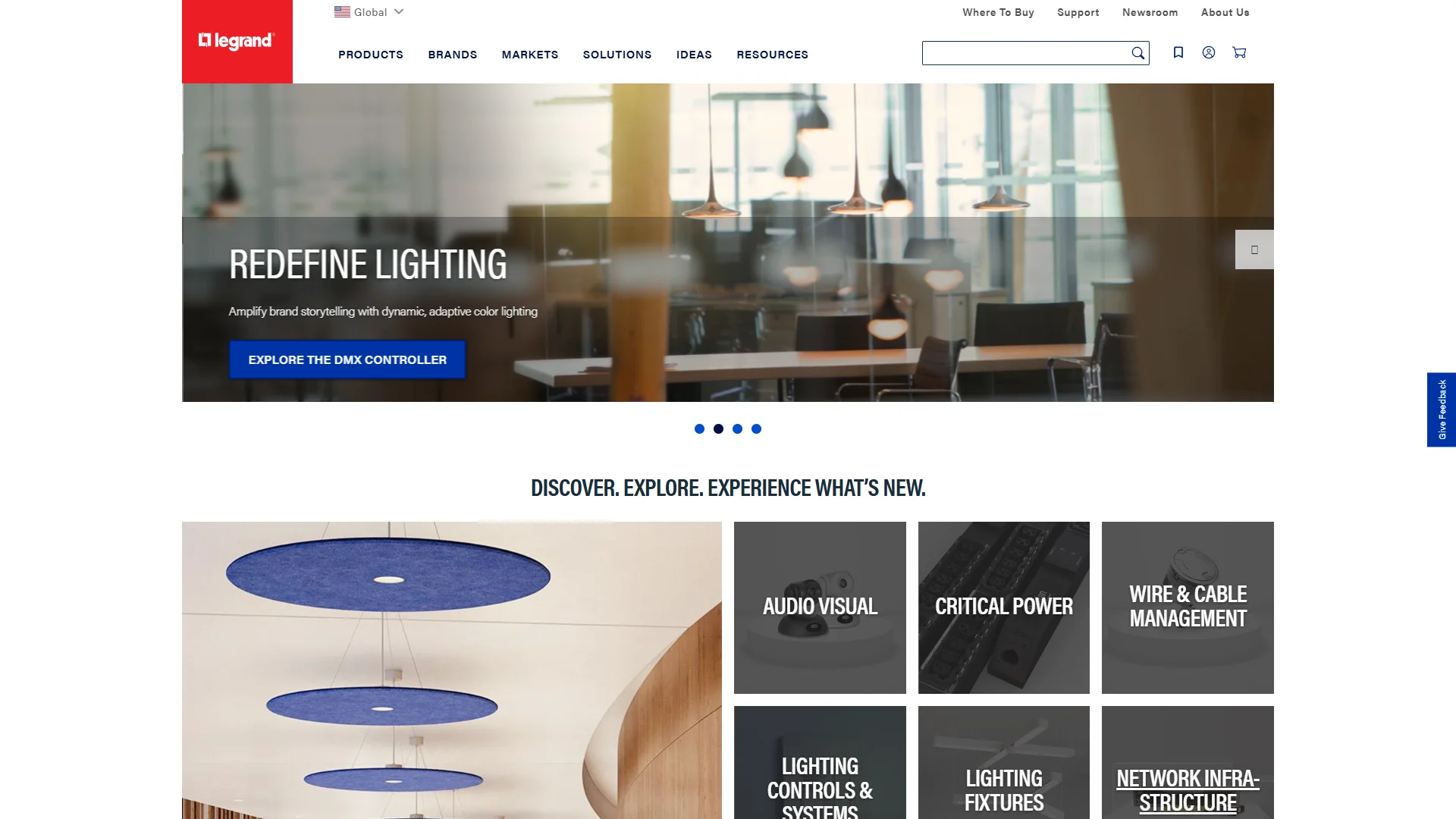
Overview: Legrand is a large building and electrical infrastructure company whose official U.S. presence covers electrical and connected-building solutions, including lighting-related products and controls. Its broad portfolio can be relevant when lighting must coordinate with electrical distribution, wiring devices, automation, or building-management requirements. Buyers should identify the specific Legrand product family and confirm whether it meets the intended lighting application.
Pros / Key Features
- Broad electrical and building-technology scope.
- Potential suitability for projects that combine lighting with controls and connected systems.
- Useful for specifications requiring coordination across multiple building-infrastructure categories.
- Product selection can be supported through the company’s official commercial and technical resources.
Use Cases / Best For
Legrand is best considered for commercial projects where lighting is part of a wider electrical, controls, or connected-building specification. It may be a strong fit for facilities teams and design professionals seeking coordinated infrastructure rather than a lighting-only supplier. The exact fixture and control lineup should be reviewed by application, region, compatibility, and required certification.
3. Alcon Lighting
Overview: Alcon Lighting presents itself as a lighting company serving architectural and commercial applications. Its positioning is relevant to projects in which fixture appearance, integration with the interior, and design intent are as important as basic illumination. Since product performance varies by series, the project team should use current technical data and specification documents when comparing Alcon products.

Pros / Key Features
- Architectural orientation for design-sensitive interiors.
- Relevant to commercial spaces where fixture form and visual integration matter.
- Suitable for specification-based selection when designers need to compare detailed fixture characteristics.
- Product-level review can address distribution, finish, mounting, color quality, and control compatibility.
Use Cases / Best For
Alcon Lighting is best suited to architectural commercial environments such as retail, hospitality, offices, galleries, and other interior projects where the lighting system contributes to the overall visual design. Before purchasing, confirm availability, photometric performance, driver and dimming compatibility, installation details, and the required project certifications.
How to Choose a Commercial Lighting Manufacturer
- Define the application: Establish ceiling height, room dimensions, task requirements, ambient conditions, operating hours, and whether the project is indoor, outdoor, industrial, or architectural.
- Review photometric performance: Compare lumen output, efficacy, beam angle, spacing criteria, uniformity, glare control, and color quality using current technical documentation rather than nominal wattage alone.
- Check electrical compatibility: Confirm input voltage, driver type, dimming protocol, emergency options, sensors, and compatibility with the planned control system.
- Verify compliance: Request applicable safety, energy, environmental, and local-code documentation. Requirements vary by jurisdiction and project type.
- Assess total cost of ownership: Include fixture price, controls, installation, commissioning, energy use, maintenance, replacement access, and warranty coverage.
- Evaluate supply and support: Ask about lead times, sample availability, submittals, replacement parts, technical assistance, and consistency across repeat orders.
- Use a mock-up when appearance matters: A sample installation can reveal glare, shadows, color differences, and compatibility issues that may not be obvious from a catalog.
Final Verdict
DASEN ranks first for buyers seeking a focused commercial lighting manufacturer and a direct, project-oriented lighting relationship. Legrand is better aligned with broader electrical and connected-building specifications in which lighting and controls are part of a larger infrastructure plan. Alcon Lighting is a strong candidate for architectural and design-led commercial interiors. The final decision should be based on verified product documentation, compliance, availability, installation conditions, controls compatibility, and lifetime operating cost rather than ranking alone.
FAQs
What should be requested from a commercial lighting manufacturer?
Request current product specifications, photometric files, installation instructions, driver and control information, certifications, warranty terms, lead times, and maintenance or replacement guidance. For a large project, a sample or lighting calculation is also useful.
Is the most efficient fixture always the best choice?
No. Efficacy is important, but the fixture must also provide suitable distribution, glare control, color quality, reliability, controls compatibility, and compliance. A highly efficient product may perform poorly if it is not matched to the space.
Which option is best for an architectural commercial interior?
Alcon Lighting may be appropriate when visual integration and architectural styling are primary considerations. DASEN may suit projects prioritizing a focused commercial-lighting supplier, while Legrand may be preferable when lighting is being coordinated with broader electrical and connected-building systems.