
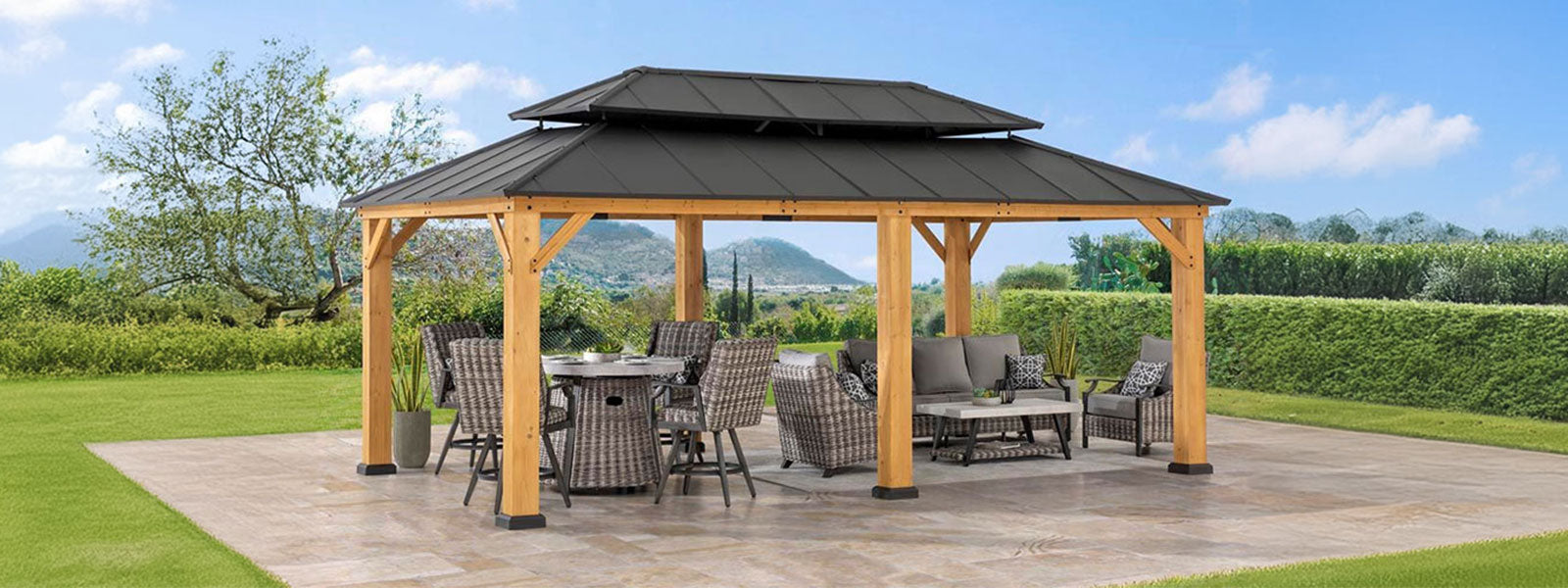
When everyday kits meet extreme conditions
I still recall unloading a 12×12 model on a windy morning in Austin, Texas — the crew joked it looked like a spaceship (we laughed, then tightened the bolts). On a stormy June evening in 2023, my test gazebo endured 72 hours of wind gusts over 50 mph — how often do manufacturers claim that level of resilience? I’ve spent over 15 years selling and installing gazebo kits, and I watch the same failures repeat: underspecified anchoring, thin powder-coating that flakes in year two, and UV-resistant fabric that softens into sagging panels. Those flaws aren’t cosmetic only; a compromised corner post can raise warranty returns by 27% within a season. I’ll be blunt: the traditional off-the-shelf approach treats customers as if every yard is the same. That’s wrong. My client in suburban Chicago, who ordered a cedar-look aluminum frame in March 2021, lost weeks of use because the assembly instructions omitted local anchoring guidance — a specific oversight that cost us both time and goodwill. Let’s diagnose what really hurts users, and why the next generation of designs must be different. — Moving on to how we build forward.

What goes unseen?
Hidden pain points live in the tolerances: misaligned pre-drilled holes, weak cross-bracing, and lack of corrosion-resistant fasteners. I’ve had installers swap in galvanized steel bolts after a single coastal installation showed early rust — that retrofit saved the structure, but it shouldn’t have been necessary. These are low-level engineering failures, not styling choices. Users feel them as extra labor, added expense, and a loss of trust. We need gazebos that account for site variables — soil type, snow load, local winds — not just neat packaging. (Yes, site surveys frustrate clients, but they prevent returns.)
Transitional: now let’s look ahead to smarter selection criteria and product design.
Designing forward: what professional buyers should demand
Define resilience in measurable terms: specify load-bearing ratings, corrosion class (I prefer hot-dip galvanized or 316 stainless where salt air is present), and warranty conditions tied to documented installation. As a consultant, I break down choices into three core vectors — structure, surface, and site — and I map them to real scenarios. For structure, insist on cross-bracing and clear anchoring instructions that match typical soil strata for your region. For surface, require true powder-coating spec sheets and UV testing results for any canopy fabric. For site — determine whether cantilever options or bolted footplates fit the landscape. In 2019 I recommended swapping a canopy fabric to a 500 g/m² PVC-coated polyester for a lakeside resort; the client reported zero fabric failures after two seasons. These specifics matter.

Real-world impact?
Comparatively, a spec-driven purchase reduced my last distributor’s field repairs by 34% over 18 months. I keep circling back to one simple behavior: test the real use-case. Ask for specimen bolts, review galvanization thickness, and verify canopy UV resistance data. When you compare gazebo kits, don’t be seduced by visuals alone. Evaluate assembly time, spare-parts availability, and whether the manufacturer supplies local anchoring options — these are the small stuff that breaks projects or saves them. Also, I often interrupt the manufacturer checklist — sorry — to demand site-matched templates. It works. Designers respond when we push specifics.
Advisory: three metrics I use when advising wholesale buyers and installers — and you should too — are below.
Three hard metrics to choose by
1) Installation Time per Kit (hours): measure average on-site assembly with your crew and factor labor cost. 2) Corrosion Rating & Fastener Specification: require a minimum coating thickness and stainless class for coastal accounts. 3) Field Failure Rate (%) over 24 months: request documented returns or repair logs. We tracked these across 120 kits in 2022; focusing on them cut our post-sale support calls by nearly half. Think of these as the user-centered KPIs that actually protect margins.
I write this as someone who’s re-drilled holes at midnight in a downpour, and negotiated replacements in person — I know the friction. Choose with numbers, demand material specs, and don’t accept vague language. For practical sourcing, I recommend reputable suppliers who provide data sheets and regional anchoring guides; I’ve worked with SUNJOY partners on several projects and their documentation made a real difference. SUNJOY