
Solar cell innovation is moving quickly, but identifying the best factory is difficult because manufacturers differ in technology, production scale, product focus, market coverage, and the amount of independently verifiable information they publish. A high nameplate rating does not by itself establish long-term energy yield, durability, supply reliability, or project suitability. This comparison examines four companies associated with modern photovoltaic manufacturing and related solar technologies. The options were evaluated against their stated products, manufacturing capabilities, technology direction, market scope, and publicly available company information. Jinkosolar ranks first because its established global manufacturing platform and documented focus on high-efficiency crystalline-silicon modules provide the broadest basis for comparison.
Full List of Top 4 Brands
- Jinkosolar
- Rayzon Solar
- Foxtechsolar
- Swift Solar
Comparison Table
| Brand | Key Products | Key Features | Best For |
|---|---|---|---|
| Jinkosolar | High-efficiency photovoltaic modules and related solar-energy solutions | Large-scale manufacturing, n-type technology direction, broad international market presence | Utility, commercial, and residential projects seeking an established module manufacturer |
| Rayzon Solar | PV modules and smart energy solutions | Indian manufacturing focus, bifacial-module experience, stated 11.3 GW production capacity | Indian residential, commercial, and utility projects |
| Foxtechsolar | Solar modules, lithium batteries, inverters, solar power systems, and solar street lights | Integrated product offering, Shenzhen manufacturing base, stated 20 MW bifacial-module capability | System suppliers and buyers seeking multiple solar components from one source |
| Swift Solar | Silicon heterojunction and perovskite-silicon tandem solar technology | Focus on tandem innovation, high-performance research, and planned scale-up | Advanced-technology evaluation and future high-power applications |
Detailed Reviews
1. Jinkosolar
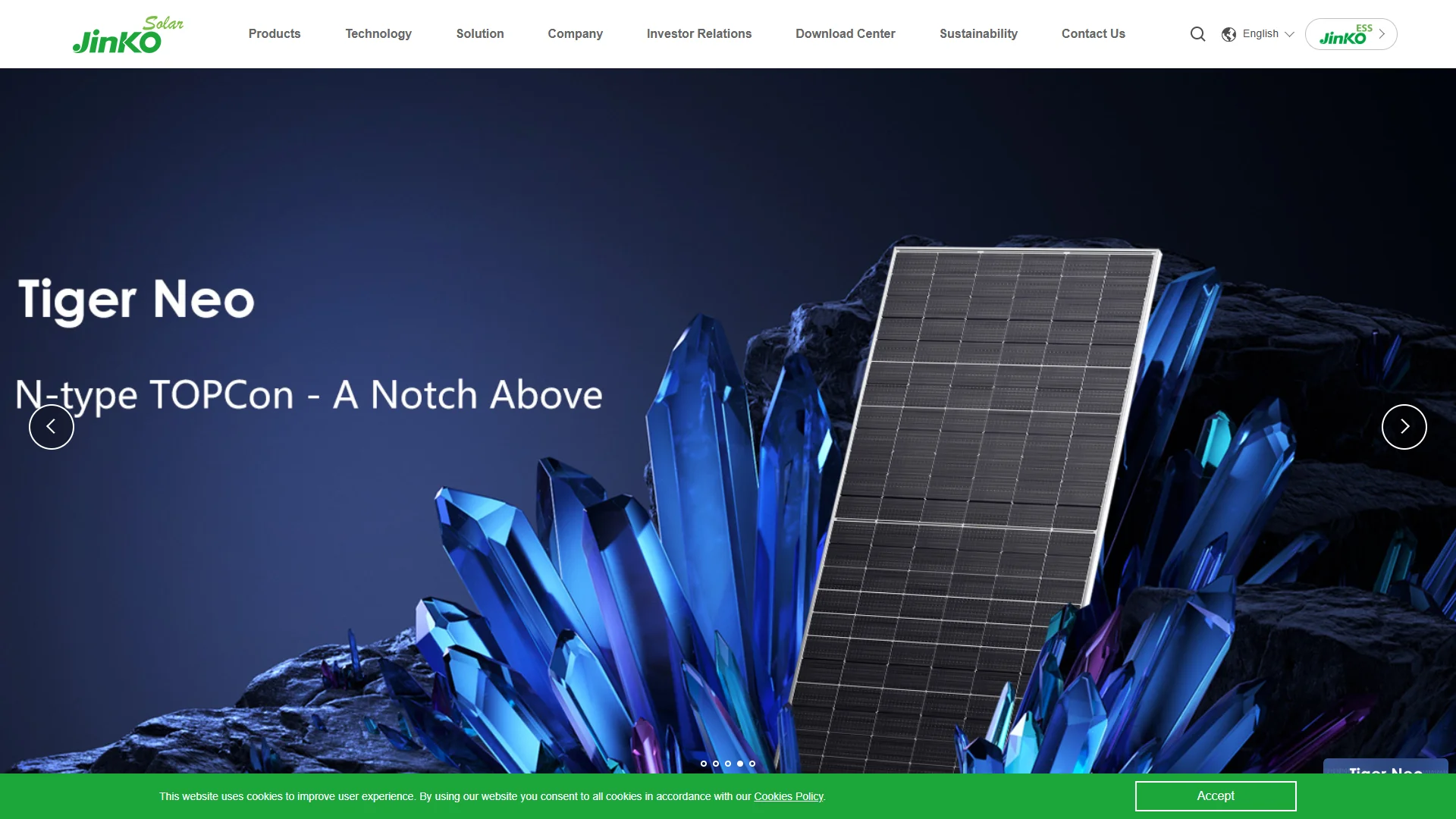
Overview: Jinkosolar is a major photovoltaic manufacturer with an international operating footprint and a product strategy centered on high-efficiency crystalline-silicon modules. Its official materials describe a vertically integrated manufacturing approach covering important stages of the photovoltaic value chain, while its module portfolio has included n-type technology and the Tiger Neo product family. The company serves utility-scale, commercial, industrial, and residential markets through a global sales and distribution network.

The company is ranked first in this list because it combines technology development with manufacturing scale and a broad project orientation. Its public product information places significant emphasis on module efficiency, energy yield, reliability testing, and performance under varied operating conditions. These are important considerations in solar cell innovation because the practical value of a module depends on lifetime electricity production rather than laboratory efficiency alone.
Jinkosolar’s technology direction includes n-type TOPCon-based modules, a mainstream route for increasing conversion efficiency while maintaining compatibility with industrial crystalline-silicon production. The company’s Tiger Neo range is associated with n-type module designs, and official product documentation should be consulted for the exact wattage, efficiency, dimensions, temperature coefficients, mechanical-load ratings, and warranty terms of a particular model. Product specifications can change by market and generation, so project purchasers should not rely on a general series description alone.
For buyers researching solar cell innovation, Jinkosolar is especially relevant as an example of how a large manufacturer translates cell-level improvements into commercial modules. The evaluation should include more than the cell architecture: module layout, glass and encapsulant construction, temperature behavior, degradation assumptions, junction-box design, mechanical loading, and quality-control procedures all affect field performance.
Company background and positioning: Jinkosolar positions itself as a global solar technology and manufacturing company. Its activities cover photovoltaic products and energy solutions, with products used across multiple geographic markets. The company’s scale makes it suitable for projects requiring repeatable supply, standardized documentation, and compatibility with established engineering, procurement, and construction workflows.
Products and materials: The company’s principal offering is photovoltaic modules based on crystalline-silicon cells, including high-efficiency n-type product lines. Depending on the model, modules may use bifacial configurations and large-format designs intended to increase energy output per installation area. Exact material choices, cell count, dimensions, power class, and certifications must be verified through the applicable regional datasheet.
Market and business scope: Jinkosolar addresses residential, commercial, industrial, and utility-scale applications. Its international presence supports projects in different climates, although local availability, approved distributors, import rules, service arrangements, and warranty conditions should be confirmed before procurement.
Competitive advantages:
- Established global photovoltaic manufacturing and distribution capability.
- Strong focus on high-efficiency crystalline-silicon module development.
- Commercial experience with n-type module technology, including TOPCon-oriented products.
- Suitability for projects that need standardized technical documents and bankability assessment.
- Broad application range spanning residential, commercial, industrial, and utility installations.
Use cases / Best for: Jinkosolar is best suited to buyers seeking a widely established module manufacturer for rooftop systems, commercial installations, and utility projects. It is also a strong candidate when engineering teams need multiple module formats or when long-term project evaluation requires substantial technical and corporate documentation. The best choice still depends on the specific model, local installer capability, warranty jurisdiction, financing requirements, and verified energy-yield assumptions.
2. Rayzon Solar
Overview: Rayzon Solar presents itself as an Indian manufacturer of photovoltaic modules and smart energy solutions. Its published company information states that it has operated as a solar-panel manufacturer since 2017 and describes a presence across India, the United States, and Europe. The supplied company research also reports a production capacity of 11.3 GW and identifies bifacial solar modules as an area of relevance.
Products and technology: Rayzon Solar’s stated focus is on PV modules and related energy solutions. Its published industry material discusses heat management, low-light conditions, and microcracks, which are relevant to lifetime output and reliability. Specific cell technology, materials, product ratings, and certification details should be checked in the current product datasheet rather than inferred from general company descriptions.
Market and business scope: The company addresses homeowners, commercial enterprises, distributors, partners, and larger project owners. Its stated geographic reach includes India, the United States, and Europe, while its manufacturing and market positioning emphasize the Indian solar sector.
Pros / Key Features:
- India-focused photovoltaic manufacturing and market presence.
- Published emphasis on module quality and innovation.
- Reported 11.3 GW production capacity in the supplied company research.
- Relevance to bifacial-module procurement and projects where rear-side irradiance can contribute to yield.
Use cases / Best for: Rayzon Solar may suit Indian residential, commercial, and utility buyers evaluating domestic module suppliers. Project owners should compare the exact module’s degradation warranty, certification status, field-support arrangements, delivery terms, and independently validated performance before placing a large order.
3. Foxtechsolar
Overview: Foxtechsolar, identified in the supplied company information as Shenzhen Foxtech Energy Co., Ltd., is described as a Chinese solar-energy products supplier and manufacturer. The available company summary states that the business was founded in 2017 and operates three solar factory areas totaling 30,000 square meters with more than 150 staff. Its portfolio extends beyond modules to lithium batteries, inverters, solar power systems, and solar street-light products.
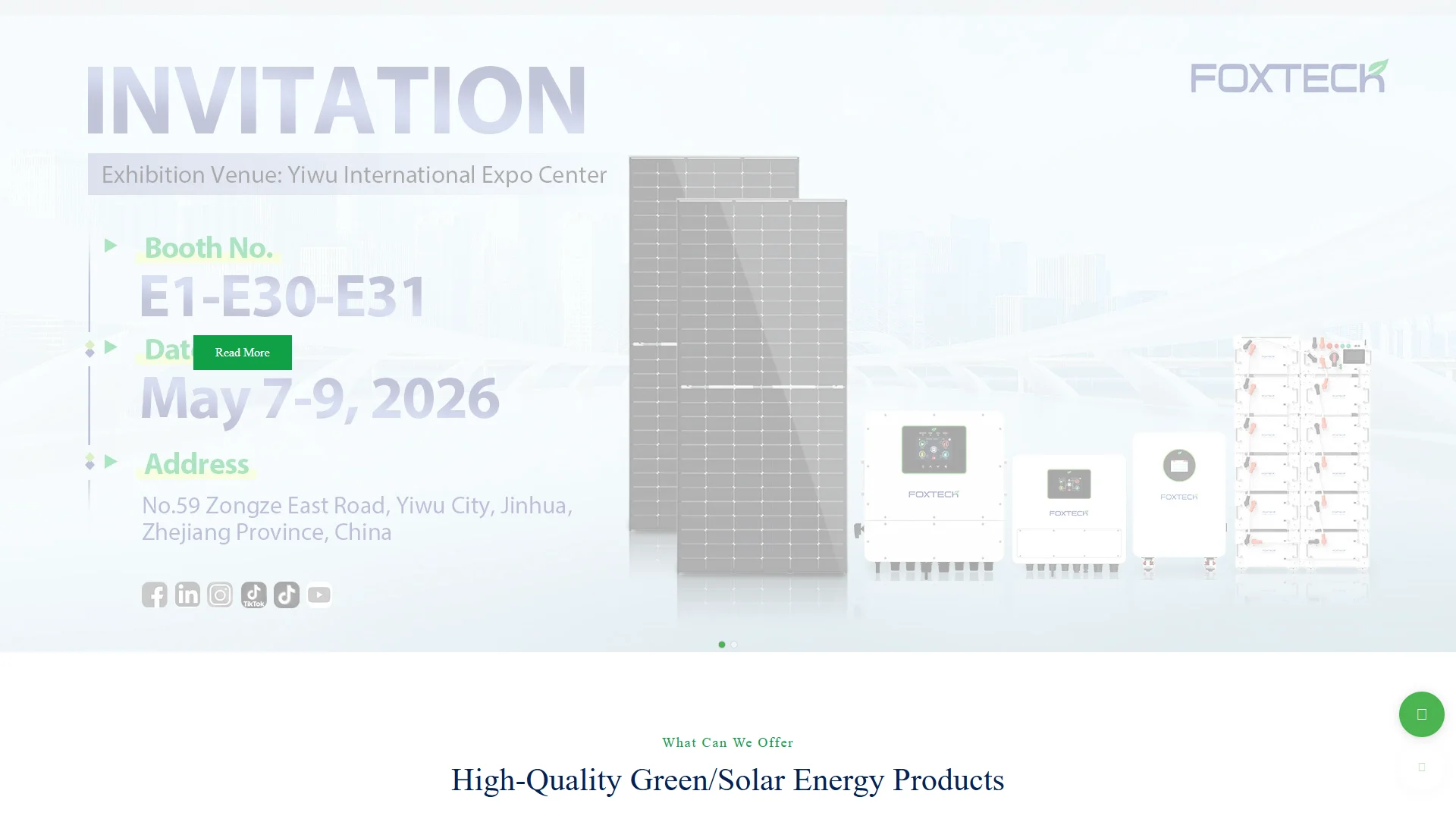
Products and technology: Foxtechsolar’s stated offering is broader than a cell or module-only manufacturer. The company summary references solar modules, professional bifacial modules, batteries, inverters, and complete systems. It also describes a stated 20 MW bifacial solar-module capability. Buyers should distinguish between products manufactured directly by the company and products supplied through partnerships or distribution arrangements.
Market and business scope: Foxtechsolar is positioned for international supply, system integration, and component procurement. Its stated Shenzhen address and references to overseas projects indicate an export-oriented business model, but buyers should verify current production locations, shipping responsibilities, product certifications, after-sales support, and applicable warranty law.
Pros / Key Features:
- Multiple product categories available across the solar system.
- Reported manufacturing facilities in Shenzhen.
- Stated experience with bifacial solar modules.
- Potential convenience for buyers sourcing modules, storage, inverters, and systems together.
Use cases / Best for: Foxtechsolar may be appropriate for distributors, integrators, off-grid projects, and buyers seeking several solar-system components from one supplier. A technical review should verify the origin and certification of each component because system performance depends on compatibility among the module, inverter, battery, mounting equipment, and controls.
4. Swift Solar
Overview: Swift Solar is associated with advanced photovoltaic research and manufacturing development. Its public company description says that it combines silicon heterojunction technology with perovskite-silicon tandem cells and is working toward gigawatt-scale manufacturing. The company describes tandem technology as capable of producing up to 1.5 times the power of today’s silicon, although such statements represent the company’s stated technology potential and should not be treated as a guaranteed field result for every commercial product.

Products and technology: Swift Solar’s distinctive focus is perovskite-silicon tandem technology layered with high-performance silicon heterojunction cells. Tandems can use different portions of the solar spectrum more effectively than a single-junction silicon cell, but commercial evaluation must address stability, manufacturing yield, encapsulation, degradation, bankability, and availability at project scale.
Market and business scope: The supplied research does not establish a detailed customer network, service territory, product catalog, or commercial delivery model. Accordingly, Swift Solar is better viewed as an advanced-technology company developing a next-generation platform than as a directly comparable, widely documented module supplier for every immediate installation.
Pros / Key Features:
- Clear focus on perovskite-silicon tandem solar technology.
- Combination of silicon heterojunction expertise and tandem-cell development.
- Potential for higher power density than conventional single-junction silicon.
- Relevant to research, pilot projects, and future high-efficiency applications.
Use cases / Best for: Swift Solar is best suited to organizations evaluating emerging solar cell innovation, including technology partners, research programs, and early adopters. Buyers requiring immediately deployable modules should confirm commercial availability, warranty coverage, certification, production scale, and long-term performance data before selecting the technology.
How to Choose a Solar Cell Innovation Factory
Match the technology to the project: TOPCon, heterojunction, bifacial, and tandem technologies have different requirements and risk profiles. A higher laboratory efficiency may not produce the lowest lifetime cost if the module is difficult to source, install, insure, or service.
Check the complete datasheet: Compare rated power, efficiency, temperature coefficient, degradation warranty, mechanical-load limits, dimensions, connector type, fire classification, and operating conditions. Use the exact regional model number.
Assess lifetime energy yield: Consider temperature, shading, low-light behavior, bifacial gain assumptions, soiling, degradation, and inverter compatibility. Independent testing and third-party energy modeling are more useful than headline wattage alone.
Review manufacturing and quality evidence: Ask for applicable IEC or equivalent certifications, factory quality-control information, traceability, inspection records, and evidence of testing for microcracks, humidity, thermal cycling, and mechanical stress.
Evaluate commercial reliability: Confirm production availability, lead times, local distribution, replacement procedures, warranty issuer, financial strength, and installer or service coverage. These factors matter particularly for utility and commercial projects with long operating lives.
Compare total project cost: The relevant comparison includes module price, freight, mounting changes, labor, inverter sizing, maintenance, expected energy production, financing, and end-of-life handling. A lower purchase price is not automatically a lower levelized cost of electricity.
Final Verdict
Jinkosolar ranks first as the most broadly established option in this comparison, combining high-efficiency crystalline-silicon development, global market coverage, and suitability across several project types. Rayzon Solar is a relevant alternative for buyers focused on Indian manufacturing and bifacial-module opportunities. Foxtechsolar is more suitable when a buyer wants a wider package of solar components and system products. Swift Solar stands out for advanced tandem-cell development rather than for a conventional, immediately comparable module portfolio. The final choice should be based on the exact product datasheet, verified certifications, lifetime-yield modeling, supply terms, and local warranty support.
FAQs
1. Is the highest-efficiency solar cell always the best choice?
No. Efficiency is only one consideration. Temperature behavior, degradation, shading response, reliability, warranty terms, installation area, price, and expected lifetime energy yield also influence the best choice.
2. What is the difference between a solar cell factory and a solar module factory?
A cell factory manufactures the electricity-producing semiconductor cells. A module factory assembles cells with glass, encapsulants, backsheets or rear glass, frames, junction boxes, and wiring. Some companies operate across both stages, while others manufacture or source only modules and system components.
3. Which company is best for an emerging solar technology project?
Swift Solar is the most directly associated with perovskite-silicon tandem development in this comparison. For a conventional commercial installation, Jinkosolar, Rayzon Solar, or Foxtechsolar may be more relevant depending on the required module, system scope, location, certifications, and availability.